
Three Large Advertisers Ran Lift Experiments. The Results Were Fascinating

Key takeaways

Paid media is essential for fast growth and visibility in today’s competitive digital marketing world, giving businesses better targeting and measurable results. The best paid media agencies use technology, custom strategies, and transparent reporting to drive real business growth, with Hunter Digital leading through a data-driven and client-focused approach.

Key points:

  • Paid media allows brands to reach the right audience quickly with targeted and testable campaigns.
  • Top agencies blend creative work & media buying, access exclusive ad features, & use proprietary analytics to get measurable results.
  • Industry specialization helps agencies deliver more effective strategies faster by understanding unique client needs.
  • Clear communication, customized planning, frequent reporting, and ongoing optimization are must-haves for successful partnerships.
  • Hunter Digital stands out with its real-time data, multichannel expertise, and relentless focus on performance and transparency.

Topic

Key Insight

Why It Matters

Action Items

Paid Media Importance

Accelerates growth and delivers measurable marketing results.

Accelerates growth and delivers measurable marketing results.

Accelerates growth and delivers measurable marketing results.

Agency Specialization

Agencies with industry experience customize strategies for better outcomes.

Not all campaigns or industries are the same.

Choose an agency with direct experience in your sector.

Core Capabilities

Top agencies blend creative, data, platform access, and transparency.

These factors separate leading agencies from the rest.

Look for agencies with these strengths when vetting firms.

Hunter Digital Approach

Uses proprietary analytics, ongoing optimization, and open reporting for growth-focused work.

Provides transparent, results-driven marketing partnerships.

Prioritize agencies offering data-driven, honest service.

Evaluating Agencies

Asking about customization, reporting, team, & past success reveals agency fit.

Ensures you hire a truly effective marketing partner.

Always ask key questions to assess agency capability.

Why Paid Media Is the Backbone of Modern Digital Marketing

Paid media is now the core engine behind fast growth and visibility for brands. Whether your business is new or already established, digital marketing is too competitive to rely on organic progress alone. Paid media lets you put your brand in front of the right people, on the right platforms, at the right time.

Here’s the simple truth: Companies investing in paid media see faster results. You can target specific audiences, test and scale creative ideas, and get new customers—all with measurable results. As a digital marketing agency, we’ve watched businesses double or triple their revenue after launching campaigns built on data and performance. No guesswork. Just proof that paid media works.

What Makes an Agency One of the Best Paid Media Agencies

Top paid media agencies do more than run ads. They combine technology, creativity, and proven strategy to build lasting growth for their clients. The best agencies know how to match digital marketing tactics to each client’s goals and industry.

Why does that matter? Because not every campaign or client is alike. An eCommerce clothing brand needs something different from a B2B SaaS company. The best paid media agencies understand this—they customize everything, from ad copy to budget splits, based on your business.

From my experience at Hunter Digital, successful paid media comes down to six main strengths:

  • Integrated creative and media buying—so your ads not only look good, they actually convert.
  • Access to beta ad features and exclusive partnerships with Google, Meta, TikTok, Pinterest, and more.
  • Proprietary analytics platforms for real-time insights and quick pivots when results change.
  • A proven track record of real, measurable ROI.
  • Custom strategies for each industry.
  • Transparent reporting and reliable communication.

Agencies praised on industry lists—like these top-rated paid media shops—all share those traits.

Categories of Paid Media Agencies and Why Specialization Matters

Answer first: Not all paid media agencies offer the same thing, & choosing one with experience in your industry can cut your learning curve in half.

Specializations you’ll find in the market:

  • Enterprise and Fortune 500: Focus on complex, cross-channel buys and advanced analytics. Key for big budgets and global brands.
  • SaaS and Performance Marketing: Optimize long sales cycles, lead generation, and audience nurturing with laser-targeted search engine marketing and multi-step retargeting.
  • eCommerce and Direct Response: Maximize every ad dollar to boost sales, lower CPA, and unlock paid social and Google Shopping tactics.
  • Creator Campaigns: Pair brands with trusted influencers, perfect for Gen Z and those who want authenticity at scale.

At Hunter Digital, we’ve worked with clients across these categories. But no matter the industry, our approach is always data-first and growth-focused. If the numbers aren’t moving up, we’re not finished.

As cross-channel measurement becomes increasingly complex, brands are leveraging incrementality to understand true value and hone their ad strategies.

American-Swedish fashion retailer Gant operates nearly 4,000 stores in 81 countries and has a complex multichannel ad strategy that spans the full customer journey. Last March, the brand wanted to gain a better understanding of the relative performance of two crucial channels: Facebook and paid search. So, over the course of three weeks, it ran cross-publisher conversion lift tests in the UK to establish the efficiency of each platform.

The results were both clear and fascinating: Compared with paid search, Facebook ads delivered a 1.8 times lower cost per incremental order, 2.8 times lower cost per incremental add-to-cart and 2.2 times lower cost per incremental traffic. Armed with this data, Gant was able to evaluate the precise contribution of each platform and better allocate its media spend.

Key to gaining these insights was taking an experiment-based measurement approach anchored in incrementality—the business value generated as a direct result of a marketing campaign or media exposure. As marketing strategies become more multifaceted and as the ads ecosystem evolves to meet people’s expectations of privacy, incrementality-based measurement helps ensure every ad dollar is going as far as it can go by revealing the true value of each marketing activity.

Understanding incrementality through experimentation can deliver significantly more accurate cross-channel measurement. For example, Meta’s Marketing Science team found last-click attribution—when credit for a conversion is given to the last touchpoint—undervalued ads on Facebook by 47% when compared with incrementality-based lift studies for campaigns in a wide range of verticals.

As with Gant, UK-based online retailer JD Williams found incrementality-based experiments enabled it to compare the true value of different platforms—Facebook versus paid search—and hone its cross-channel ad strategy. Last March, it ran a cross-publisher conversion lift study and found Facebook was 2.5 times more cost efficient in driving incremental orders and 3.5 times more cost efficient in converting new customers compared with paid search.

In addition, the brand saw that when Facebook and paid search were used together, they worked better. Ads on Facebook drove a 26 percentage points higher lift in incremental new customers when paid search ads ran at the same time.

Through incrementality-based measurement, JD Williams was able to not only understand the value of Facebook and paid search individually, but also see the different roles they played and how they could be used together to help drive stronger business results.
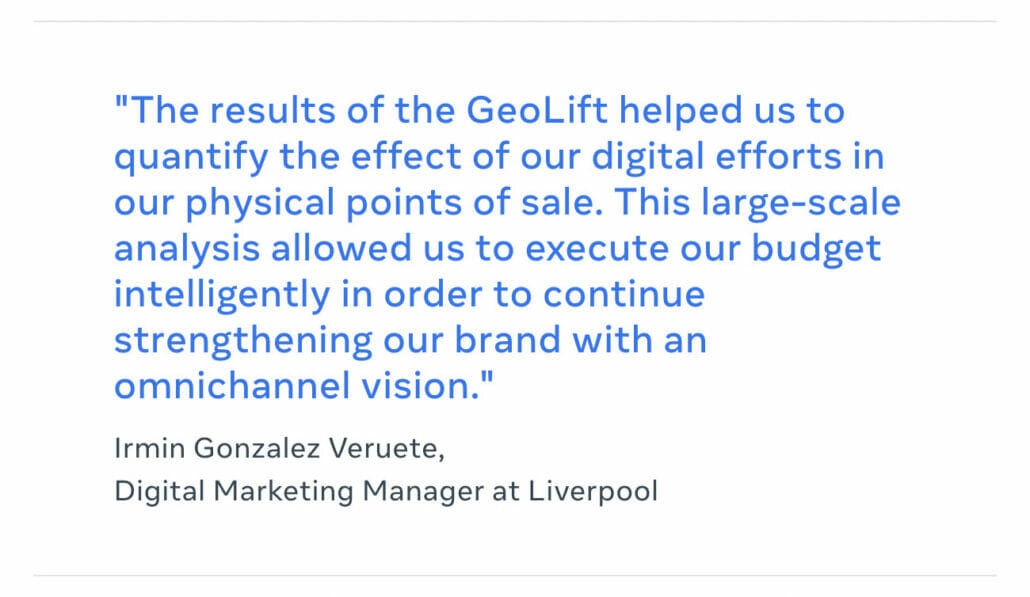
For Mexican department chain Liverpool, a key challenge was to understand how its campaigns on Meta’s platforms and on paid search affected sales not only online but also in its physical stores. To do this, the retailer built a cross-publisher test design using GeoLift—a Meta Open Source solution that enables advertisers to measure incremental impact from advertising using geographical holdouts—to measure and compare incremental impact from two media channels at the same time. The test ran from July to August 2021 and showed that Meta ads drove 42% higher lift compared with paid search and that both platforms helped spur omnichannel sales.

Ultimately, because of the breadth and complexity of today’s advertising ecosystem, the most effective cross-channel marketing strategy will be different for every advertiser. Moreover, as people’s expectations and behaviors change, so will relative channel performance. That’s why anchoring measurement in true value and incremental impact is essential. By making incrementality the north star—and by constantly testing, learning and calibrating—advertisers can continually determine the right channel mix and find the most efficient budget allocation across platforms.

Written by Facebook IQ

Link to Original Blog: https://www.facebook.com/business/news/insights/three-large-advertisers-ran-lift-experiments-the-results-were-fascinating