
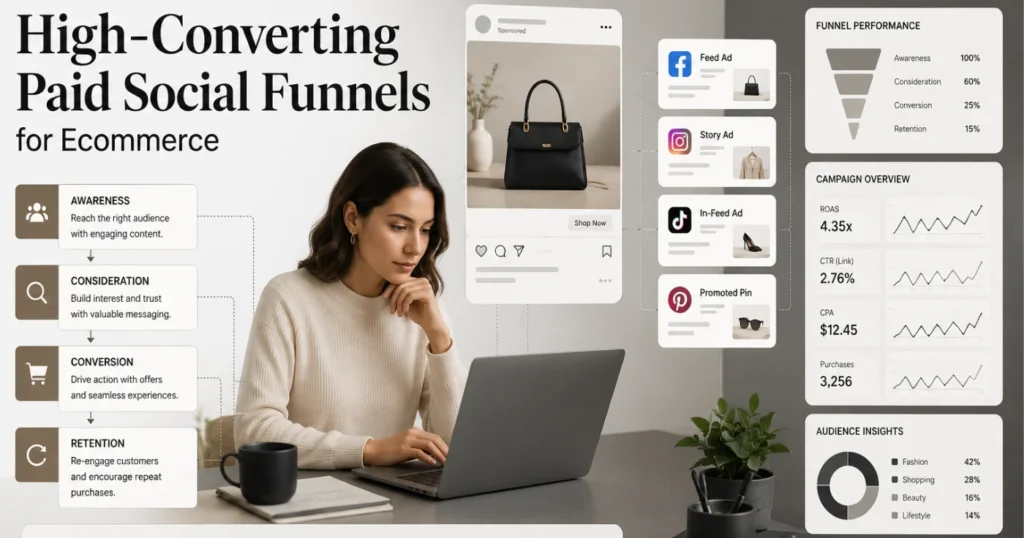
Paid social advertising has become one of the most effective growth channels for ecommerce brands, but running ads alone is no longer enough. Increasing competition, rising customer acquisition costs, and shorter consumer attention spans mean ecommerce companies need a structured strategy that guides potential buyers from awareness to conversion.
The most successful ecommerce brands build paid social funnels that combine audience targeting, creative testing, landing page optimization, and retargeting into one connected system. Instead of relying on single campaigns, they focus on creating a customer journey that gradually builds trust and buying intent.
A strong funnel-based approach helps ecommerce businesses improve conversion rates, lower customer acquisition costs, and generate more predictable revenue from platforms like Facebook, Instagram, TikTok, Pinterest, and YouTube.
What Is a Paid Social Funnel for Ecommerce?
A paid social funnel is the step-by-step process consumers follow after interacting with a social media advertisement. Rather than immediately pushing users to purchase, the funnel moves shoppers through different stages designed to educate, engage, and convert them over time.
Most ecommerce paid social funnels are divided into three stages:
Funnel Stage | Primary Goal | Recommended Ad Types |
Top of Funnel (TOFU) | Build awareness and attract new audiences | Video ads, UGC content, lifestyle creatives |
Middle of Funnel (MOFU) | Increase engagement and trust | Product demos, testimonials, educational ads |
Bottom of Funnel (BOFU) | Convert high-intent users into customers | Retargeting ads, offers, cart abandonment ads |
Many ecommerce brands fail because they try to sell immediately to cold audiences. A funnel-based strategy works better because it aligns messaging with the customer’s level of intent throughout the buying journey.
Why Ecommerce Brands Need Funnel-Based Paid Social Strategies
Modern shoppers rarely purchase after seeing only one advertisement. Consumers often engage with multiple ads, reviews, landing pages, and social proof elements before making a buying decision.
This is why high-performing ecommerce brands focus on funnel optimization rather than isolated campaigns. Agencies such as Hunter Digital Marketing emphasize performance-driven paid media strategies that align creative, targeting, and conversion optimization to improve scalability and profitability. Their ecommerce-focused campaigns are designed to maximize revenue while maintaining efficient return on ad spend (ROAS).
When paid social funnels are properly structured, ecommerce brands often experience:
- Higher conversion rates
- Lower customer acquisition costs
- Increased average order value
- Better audience segmentation
- Improved customer lifetime value
- More consistent scaling opportunities
The goal is not simply generating traffic. The objective is building a predictable customer acquisition system that turns social engagement into long-term revenue growth.
Top of Funnel: Building Awareness and Demand
The top of the funnel focuses on attracting new audiences and introducing consumers to your brand.
At this stage, most users are unfamiliar with your products and may not even recognize the problem your product solves. The primary objective is capturing attention and generating curiosity.
Successful TOFU campaigns typically include:
- User-generated content (UGC)
- Lifestyle-focused videos
- Problem-solution storytelling
- Short-form vertical videos
- Founder-led content
- Educational product demonstrations
Authentic creative tends to perform better than highly polished advertisements because it blends naturally into social feeds and feels more trustworthy to users.
Broad audience targeting is often more effective during this stage. Ecommerce brands frequently use lookalike audiences, interest targeting, and algorithmic optimization to help platforms identify potential buyers.
Creative testing also becomes extremely important. Brands that consistently test new hooks, messaging angles, and visual formats usually discover winning creatives faster and maintain stronger campaign performance over time.
Middle of Funnel: Building Trust and Engagement
After users interact with top-of-funnel ads or visit your website, they move into the consideration stage.
This stage is designed to educate shoppers, answer objections, and build trust before asking for a purchase. Consumers often need reassurance before committing to an ecommerce transaction, especially if they are unfamiliar with the brand.
Effective MOFU campaigns commonly use:
- Customer testimonials
- Product comparison content
- Influencer reviews
- Educational videos
- Before-and-after demonstrations
- Social proof messaging
Retargeting becomes especially valuable here. Users who viewed products, watched videos, or engaged with social content should receive messaging tailored to their previous interactions.
For example:
- Video viewers can receive product-focused ads.
- Product page visitors can receive customer testimonials.
- Returning website visitors can receive educational comparison content.
Personalized retargeting helps increase relevance while moving users closer to conversion.
Bottom of Funnel: Driving Ecommerce Conversions
Bottom-of-funnel campaigns target users who already know your brand and are close to making a purchase decision.
These campaigns focus heavily on conversion optimization and urgency-driven messaging.
Common BOFU strategies include:
- Dynamic product ads
- Cart abandonment campaigns
- Limited-time offers
- Free shipping promotions
- Product review ads
- Urgency and scarcity messaging
Landing page performance becomes critical during this stage. Even highly optimized ad campaigns can fail if the ecommerce website creates friction during checkout.
The highest-converting ecommerce landing pages usually include:
- Fast mobile load speeds
- Clear product benefits
- Simplified navigation
- Strong customer reviews
- Easy checkout experiences
- Visible calls to action
Mobile optimization is particularly important because the majority of paid social traffic now comes from mobile devices.
Why Creative Testing Matters in Paid Social Funnels
Creative performance has become one of the biggest success factors in paid social advertising.
As advertising platforms rely more heavily on automation and machine learning, creative quality often influences campaign results more than manual audience targeting.
Successful ecommerce brands continuously test:
Creative Format | Funnel Stage | Main Objective |
UGC Videos | TOFU | Capture attention and increase engagement |
Product Education Videos | MOFU | Explain product value and features |
Customer Testimonials | MOFU | Build trust and reduce objections |
Offer-Based Ads | BOFU | Increase conversion rates |
Brands that produce multiple creative variations can identify high-performing messaging faster while reducing the impact of ad fatigue.
This testing process helps maintain performance consistency as campaigns scale across larger audiences.
The Importance of Retargeting in Ecommerce Funnels
Retargeting remains one of the highest-performing components of ecommerce paid social strategies because it focuses on users who already demonstrated interest in your brand.
High-converting retargeting campaigns often target:
- Website visitors
- Product page viewers
- Video viewers
- Add-to-cart users
- Existing customers
- Email subscribers
The messaging should become increasingly conversion-focused as buyer intent grows stronger.
For example, first-time website visitors may receive educational content, while cart abandoners may receive urgency-based messaging or limited-time offers.
Performance-focused agencies like Hunter Digital Marketing often structure retargeting campaigns around audience behavior data to improve efficiency and maximize return on ad spend across the entire funnel.
Common Paid Social Funnel Mistakes Ecommerce Brands Make
Many ecommerce businesses struggle with paid social because they focus too heavily on immediate sales rather than long-term funnel performance.
Some of the most common mistakes include:
Sending Cold Traffic Directly to Product Pages
New audiences often require education before they are ready to purchase. Brands that skip awareness-building stages may experience lower conversion rates.
Ignoring Creative Fatigue
Social audiences become fatigued quickly when repeatedly shown the same ads. Consistent creative refreshes are necessary to maintain performance.
Weak Tracking and Attribution
Without accurate attribution systems, ecommerce brands struggle to understand which campaigns and funnel stages are generating revenue.
Poor Mobile User Experience
Slow-loading mobile pages or complicated checkout processes can dramatically reduce conversion rates.
Overusing Discounts
Heavy discounting may increase short-term sales but can hurt profitability and weaken long-term brand positioning.
Building a Full-Funnel Paid Social System That Scales Profitably
Building a high-converting paid social funnel requires more than launching ads on Facebook or Instagram. Ecommerce brands must create a complete customer journey that guides users from awareness to consideration and ultimately to conversion.
The most successful paid social strategies combine strong creative, audience segmentation, retargeting, and landing page optimization into one cohesive system. Brands that adopt a funnel-first mindset consistently improve conversion rates, increase return on ad spend, and scale more profitably over time.
Companies working with ecommerce-focused agencies such as Hunter Digital Marketing often prioritize full-funnel growth strategies because they create more sustainable and measurable long-term results.
FAQs
What is a paid social funnel for ecommerce?
A paid social funnel is a systematic approach to advertising that takes users from the awareness stage through to purchase, attracting them with specific ads based on where they are in the customer journey.
Why do ecommerce brands need paid social funnels?
These help cut acquisition costs, increase efficiency in ad performance, and drive more conversions by delivering the right message to the right audience within their journey.
What are the stages of a paid social funnel?
A marketing funnel typically consists of three stages: Top of Funnel (awareness), Middle of Funnel (consideration) and Bottom of Funnel (conversion), frequently accompanied by retargeting and retention campaigns.
Which platforms work best for paid social funnels?
Meta (Facebook & Instagram), TikTok, and Pinterest – Usually high-user engagement options for ecommerce brands with great targeting abilities.
How does retargeting improve funnel performance?
By targeting users who have already interacted with your brand, retargeting allows you to serve them personalized ads which increases conversion rates and decreases wasted ad spend.